
Citywide No Turn on Red
Streets Forward’s Citywide No Turn on Red Initiative is calling for the City to install No Turn on Red signs at every traffic light in San Francisco.. Why? No Turn on Red signs makes intersections 50% safer for all people—including during green lights—and 90%+ of people driving comply with No Turn on Red signs without enforcement. Best of all, installing No Turn on Red signs at every traffic light will only cost the City $250,000 total.
Support the No Turn on Red Initiative by signing the petition now.
Safer Intersections and Crossings for All.
Sign the petition:
The Citywide No Turn on Red Initiative is part of the Intuitive Intersection Initiative, a three-pillar solution to get the City to paint every crosswalk (The Complete Crosswalks Campaign), add bike and scooter parking in every daylighting zone, and implementing No Turn on Red signs at every traffic light.
This initiative is led by Streets Forward, a local nonprofit initiative making it safe, fast, and easy to get around San Francisco. Get involved at StreetsForward.org/volunteer and support the organization’s work by making a gift at StreetsForward.org/give.
A Low-Cost, Systems-Level Safety Solution
For over two years, Streets Forward has been advocating for the City to install No Turn on Red signs at all traffic lights in San Francisco.
In response to SFMTA’s announcement of Phase 3 of the No Turn on Red Expansion Project, Streets Forward is renewing its call for the Mayor and Board of Supervisors to publicly support installing No Turn on Red signs at every traffic light in San Francisco and for SFMTA to install No Turn on Red signs at the remaining ~650 intersections as Phase 4 of its Expansion Project.
Following the approval of Phase 3, about 50% of San Francisco’s 1,251 intersections with traffic lights (also known as signalized intersections) will have No Turn on Red signs. Having to think about and figure out which 50% of the City’s traffic lights have No Turn on Red signs and which don’t is a recipe for confusion and disaster for everyone, especially people driving.
No Turn on Red signs are a proven safety measure that decreases injuries by up to 50% for all people, including those in cars (United States Department of Transportation). No Turn on Reds also increase safety during green lights (Institute of Transportation Engineers Journal). Greater than 90% of people driving comply with No Turn on Red signs without enforcement, while “close calls” and cars blocking the crosswalk decreased by greater than 70% (SFMTA).
Best of all, the City could achieve 100% No Turn on Red coverage for just $258,400 by using the same funding mechanism as the Phase 2 of SFMTA’s Expansion Project (SFCTA).
Past and Present of No Turn on Red (NTOR) in SF
Phase 1: Tenderloin (2021)
In response to then-Supervisor Matt Haney calling for No Turn on Red signs to be installed at all traffic lights in the Tenderloin, SFMTA installed No Turn on Red signs at 54 intersections, bringing the total number of intersections with No Turn on Red signs in the Tenderloin to 57. The total cost for signs and labor was $78,821 at $375.34 per sign (project page, SFCTA Prop K funding request form).
Streets Forward Advocacy & Board of Supervisors Nonbinding Resolution (2023)
Advocacy by Streets Forward won a nonbinding resolution from the Board of Supervisors urging SFMTA to implement a citywide No Turn on Red policy. Notably and unfortunately, a clause specified implementation should be completed “to the greatest extent possible,” hindering citywide implementation.
Phase 2: Downtown Expansion (2024)
In March 2024, SFMTA Traffic Engineer Ricardo Olea approved installing No Turn on Red signs at 207 additional intersections, largely concentrated in downtown San Francisco (e.g. Financial District, SoMa). The exact cost of this expansion is unclear because funding was part of a larger request, but 90% of the total costs were covered by a Federal Highway Administration grant which required only a 10% match, which came from SFCTA Prop L funds (project page, progress map, funding request).
Later in the year, at an August 6, 2024 SFMTA Board meeting, City Traffic Engineer Olea said that Streets Forward’s petition for a citywide No Turn on Red policy had, “been helpful in the sense of creating energy and support around the initiatives around turn on red.” Previous presentations (1,2) and a future staff report also referenced the petition and its positive impact on SFMTA’s efforts to expand No Turn on Red.
Phase 3: About 50% of Traffic Lights with No Turn on Red
On November 13, 2026, SFMTA will propose installing No Turn on Red signs at more than 150 additional intersections throughout San Francisco, largely concentrated along the northern waterfront, Van Ness Avenue, Franklin Street, and Gough Street, and parts of the Mission. Assuming Phase 3 is approved, about 50% of all intersections with traffic lights will have No Turn on Red signs installed.
Proposed Phase 4: No Turn on Red signs at every traffic light
Given the extensive research and data on the safety benefits of No Turn on Red, the severity of San Francisco’s traffic safety crisis, and the relatively small cost to install No Turn on Red signs at every traffic light in San Francisco, it’s past time for the City to implement this proven safety measure.
Rather than continue with a long, drawn-out, incremental approach to expanding No Turn on Red, now is the time for the City to take a systems-level approach to this safety issue by achieving 100% No Turn on Red coverage throughout the city, and make intersections safer for people in every neighborhood.
At a cost to the City of about $250,000, every intersection in San Francisco with a traffic light can be made up to 50% safer. Mayor Lurie says street safety is public safety, and this is one of the lowest cost, highest leverage safety improvements the City can make today.
Streets Forward Analysis
Streets Forward analyzed numerous datasets from the City to visualize which intersections with traffic lights would No Turn on Red signs after Phase 3 is approved and which would still need No Turn on Red signs to make them safe.
We also analyzed intersections by supervisor district to help policymakers and the public understand which districts had the highest percentage of traffic lights with No Turn on Red signs and which districts needed the fewest No Turn on Red signs to reach 100%.
Map
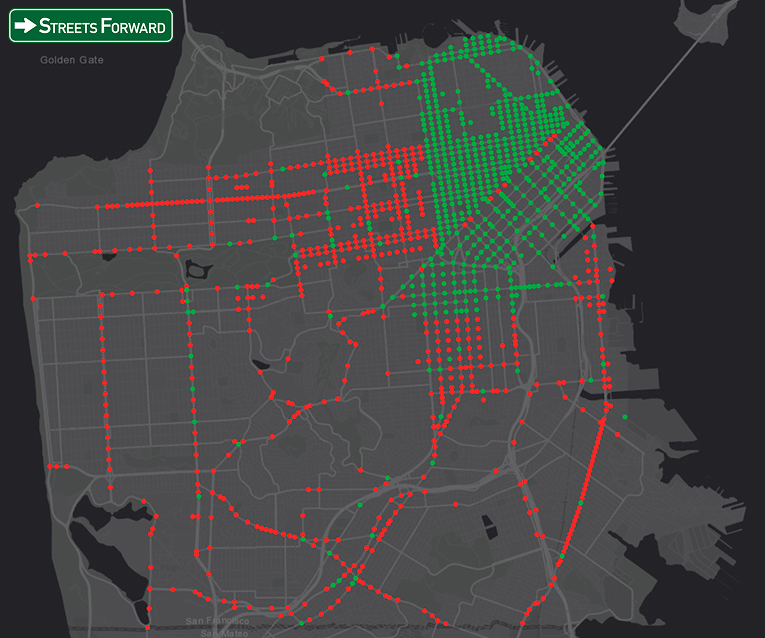
Note: Map reflects which intersections will have No Turn on Red signs installed when Phase 3 is complete
Supervisor District Breakdown
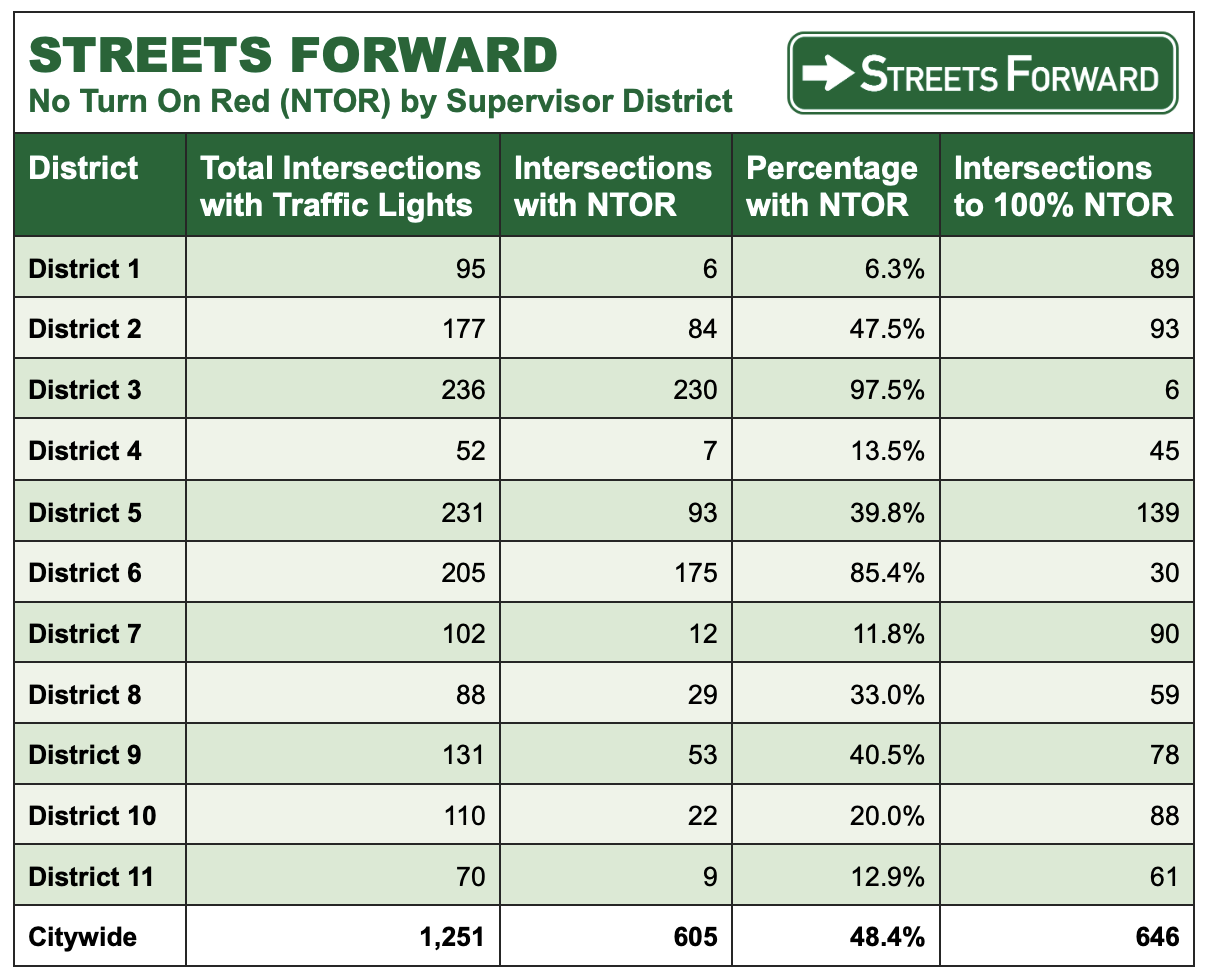
Note: Intersections on the border of two districts are included in each district’s count; Citywide does not double-count
Methodology
Data Acquisition & Baseline Filtering: The analysis utilizes official San Francisco Municipal Transportation Agency (SFMTA) datasets for Traffic Signals and Street Signs, both dated November 2, 2026. The initial dataset was filtered to strictly include standard signalized intersections. Midblock signals—which lack an intersecting cross street—were systematically removed from the dataset. Seven intersections on Sunset Dunes—the roadway formerly known as Upper Great Highway—were excluded because Upper Great Highway was converted to Sunset Dunes (and closed to cars) on March 14, 2025.
Identification of Existing Restrictions: To establish an accurate baseline of current restrictions, the Street Signs dataset was filtered for active "No Turn on Red" signage. Signage indicating "STOP," "CROSSWALK," or "PERMITTED" was excluded to prevent false positives. Intersections with verified existing NTOR signs were cross-referenced using their unique CNN (intersection ID) and/or manually confirmed, then marked as baseline-compliant.
Geographic Boundary Definitions (Phases 1–3): The geographic scope for the phased rollouts was defined using precise polygon bounding boxes based on SFMTA project parameters:
Phase 1 & 2: Bounding polygons were established for the Tenderloin and Downtown.
Phase 3: Two distinct bounding polygons were generated to capture the expansion areas—one for the North of Market region (bounded roughly by Broadway, Embarcadero, Van Ness, and Gough) and one for the Mission region (bounded roughly by 11th, Market, Sanchez, 18th, and Harrison).
Geospatial District Assignment & Border Handling: To calculate the metrics per supervisorial district, the intersection coordinate points were converted to a localized geospatial projection and cross-referenced against the Supervisor Districts (2022) dataset. Intersections falling on the border of two or three districts are counted toward the total for each adjacent district in the district-level breakdown. However,the Citywide total strictly deduplicates these border intersections to provide a true, absolute count of affected intersections across the entire city.
Related datasets from DataSF:
Frequently Asked Questions (FAQ)
What about compliance and enforcement? Won’t people just ignore the signs?
A common assumption is that people driving don’t obey No Turn on Red signs and that armed traffic enforcement will be necessary to see the safety benefits of No Turn on Red signs. Fortunately, the data says the exact opposite. SFMTA’s Tenderloin No Turn on Red Evaluation in 2021/2022 found that 92% of people driving complied with No Turn on Red signs, during a time when traffic citations issued by SFPD were at historic lows. In addition to an extremely high rate of compliance, “close calls” between cars and people walking decreased by 80% and cars blocking or encroaching crosswalks during a red light decreased more than 70%. The data is clear—installing No Turn on Red signs makes intersections safer for all people and No Turn on Red signs have a high rate of compliance and don’t require enforcement.
If people can’t turn on red, won’t that make turns on green more dangerous?
Another common assumption is that installing No Turn on Red signs will make turns on green more dangerous (or make it more dangerous to cross the street during a green light). Fortunately, the data says the exact opposite. A comprehensive analysis of intersections with No Turn On Red signs in Washington, DC showed a 59% decrease in people driving failing to yield to people walking during green lights (and a 92% decrease during red lights). The same analysis showed a 76% decrease in turn-on-red violations and a 97% decrease in conflicts between cars at intersections with No Turn on Red signs.
How much will citywide implementation cost?
Based on the funding for Phase 2 of the SFMTA’s No Turn on Red Expansion Project, the City could achieve 100% No Turn on Red coverage for only $258,400, which would come from SFCTA Prop L funds as a 10% match on a Highway Safety Improvement Program (HSIP) grant administered by the Federal Highway Administration (FHWA) through Caltrans which would cover 90% of the total cost, estimated to be $2,584,000, based on SFMTA’s estimate of $4,000 per intersection.
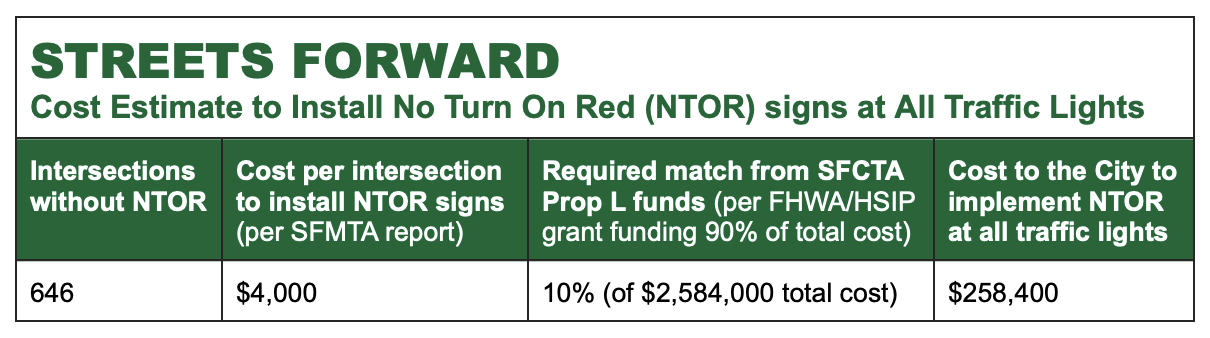
Sources:
$4,000 cost per intersection: SFMTA report
Required match from SFTA Prop L funds: FHWA/HSIP grant funding 90% of total cost
What does the research say about No Turn on Red?
SFMTA found that, at intersections in the Tenderloin where it implemented No Turn On Red at all intersections in the neighborhood in 2021 following then-Supervisor Matt Haney calling for the policy, 92% of people driving compiled with NTOR, “close calls” between cars and people walking decreased by 80%, and cars blocking or encroaching crosswalks during a red light decreased more than 70%.
Separately, SFMTA found that 20% of injury crashes at signalized intersections involving a person walking or biking resulted from a person driving turning on red.
An analysis of intersections with No Turn On Red in Washington, DC showed a 92% decrease in people driving failing to yield to people walking at red lights (and a 59% decrease at green lights), a 76% decrease in turn-on-red violations, and a 97% decrease in conflicts between cars.
A National Highway Traffic Safety Administration (NHTSA) report found that allowing turns on red increased crashes involving people walking by 44% and people on bikes by 59%.
A separate NHTSA report found that turn-on-red crashes frequently involved people walking or on bikes, with 22% of all crashes involving a person walking or on a bike, and 93% of those crashes resulting in an injury.
Another study found that allowing turns on red resulted in a 23% increase in all turn crashes, a ~60% increase in crashes involving people walking, and a ~100% increase in crashes involving people on bikes.
A United States Department of Transportation (USDOT) report showed that allowing turns on red increased injury crashes involving people walking by up to 107% and crashes involving people biking by up to 80%, in part because "drivers stopped for a red light are looking left for a gap in traffic and do not see pedestrians and bicyclists coming from their right."
Another study found that allowing turns on red increased crashes by 25% in cities and increased crashes involving children walking by 30%, people walking by 100%, and elderly people by 110%.
A study by San Jose State University’s Mineta Transportation Institute found that “[turn on red] movements movements are generally unsafe for pedestrians, bicyclists, and drivers and hinder the livability of streets for vulnerable road users.” It also stated that, “Despite [turn on red] crashes being a small portion of collisions and fatalities at signalized intersections, they tend to be more severe for vulnerable road users (e.g., bicyclists and pedestrians).” Finally, it stated that “[turn on red] prohibition is a proactive safety strategy consistent with the internationally recognized and USDOT-adopted Safe Systems approach” and recommended that “state policy should make it easier for California communities to prohibit [turn on red] movements.”
Support the Complete Crosswalks Campaign by signing the petition above now.
The Citywide No Turn on Red Initiative is part of the Intuitive Intersection Initiative, a three-pillar solution to get the City to paint every crosswalk (The Complete Crosswalks Campaign), add bike and scooter parking in every daylighting zone, and implementing No Turn on Red signs at every traffic light.
These improvements are proven to significantly increase safety for all people, help people shift trips to walking, transit, biking, and scooting, get bikes and scooters off sidewalks, and free up space for local businesses to put seating and tables on sidewalks.
This initiative is led by Streets Forward, a local nonprofit initiative making it safe, fast, and easy to get around San Francisco. Learn more about Streets Forward at StreetsForward.org, get involved at StreetsForward.org/volunteer, and support the organization’s work by giving at StreetsForward.org/give.